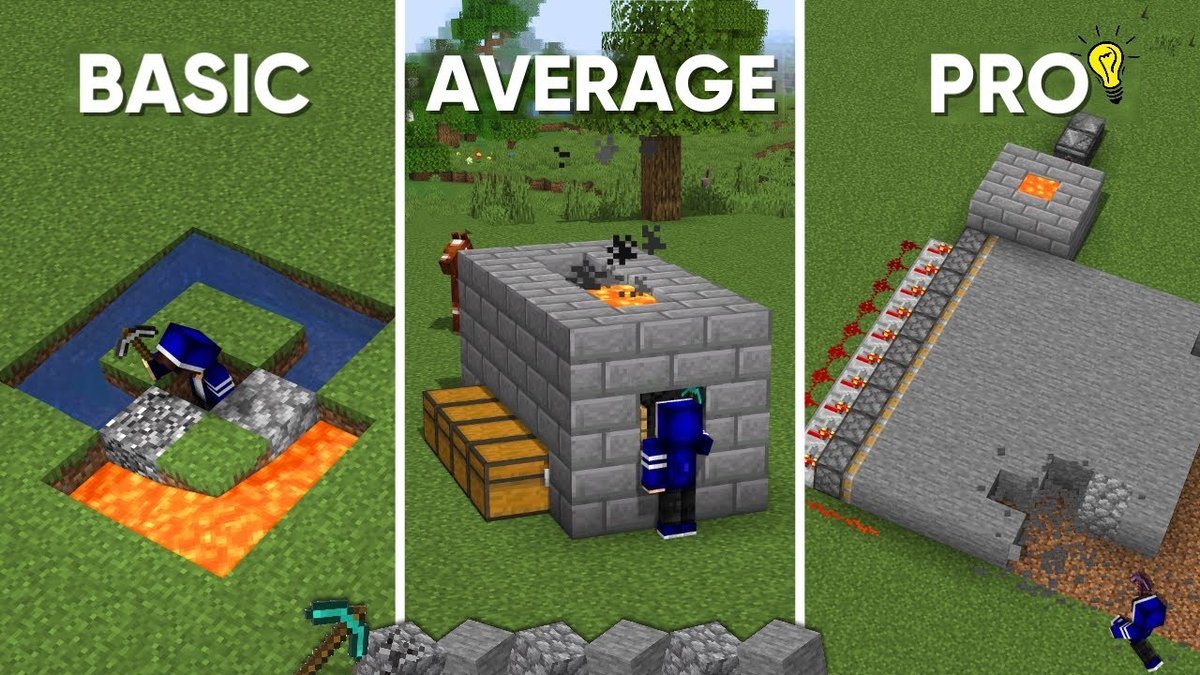
In the expansive, blocky worlds of Minecraft, efficient resource gathering is the bedrock of grand construction and complex automation. While breaking individual blocks is the classic approach, seasoned players quickly learn that manual labor has its limits. This is where Automated & Advanced Cobblestone Generators step in, transforming a tedious chore into a hands-off operation that fuels your most ambitious projects, from mega-bases to elaborate Redstone contraptions.
These sophisticated systems go far beyond a simple water-lava setup, offering unparalleled production rates and often featuring clever mechanisms to manage output and minimize game performance issues. If you're ready to graduate from pickaxe-wielding miner to master of automated production, you've come to the right place.
At a Glance: Crafting Infinite Cobblestone
- Renewable Resource: Cobblestone is infinitely renewable through the interaction of water and lava.
- Production Powerhouse: Advanced generators can churn out anywhere from 32,400 to over 230,000 cobblestone blocks per hour.
- Beyond Basic: They move past simple setups, incorporating Redstone, pistons, observers, and even TNT dupers for maximum efficiency.
- Lag Reduction: Smart designs often include features to automatically shut down when storage is full, preventing chunk corruption and server lag.
- Scalable: Many advanced designs are modular, allowing for easy expansion to meet ever-growing demands.
- Versatile Output: Depending on pickaxe enchantments (Fortune for more cobblestone, Silk Touch for smooth stone), you can customize the generator's ultimate product.
The Elemental Dance: How Cobblestone Springs to Life
At its heart, any cobblestone generator relies on a fundamental Minecraft mechanic: the interaction between water and lava. When flowing lava meets flowing water, it creates cobblestone. The trick to consistent generation lies in carefully controlling the flow directions to ensure this specific interaction occurs repeatedly in the same spot.
To clarify, not all water-lava interactions yield cobblestone:
- Flowing Water + Still Lava: This combination results in Obsidian, a hard-to-mine block.
- Flowing Lava + Still Water: Produces regular Stone blocks.
- Flowing Lava + Flowing Water: The magic formula for Cobblestone. This is the interaction you need to engineer for your generator.
Understanding this principle is the first step toward building any generator, simple or advanced. For a refresher on the basics, you might want to revisit how to make a cobblestone generator to solidify your foundational knowledge.
Why Push the Limits? The Case for Advanced Automation
Why bother with complex Redstone and intricate contraptions when a basic setup can provide cobblestone? The answer lies in scale, efficiency, and player freedom.
- Massive Resource Needs: Building large structures, fortresses, or complex Redstone circuits demands tens of thousands, if not hundreds of thousands, of cobblestone. Manually mining this volume is incredibly time-consuming.
- Time Savings: An automated generator works while you're exploring, building, or even offline (on a server). It's passive income for your inventory.
- Reduced Labor: No more holding down the mouse button for hours. Let the machines do the grinding.
- Optimized Performance: Well-designed advanced generators manage item drops and block updates intelligently, minimizing the impact on your client and server performance. Simple, uncollected generators can create significant lag.
- Expandability: Advanced designs are often modular, meaning you can easily scale them up by adding more units, multiplying your production rate exponentially.
The shift from manual mining to automated generation is a game-changer, allowing players to tackle projects that were once impossibly resource-intensive.
Evolving Your Production: From Pickaxe to Pistons
Minecraft offers a spectrum of generator designs, each building on the last in complexity and efficiency. While we're focusing on advanced methods, it’s helpful to understand the progression.
The Simple Start: Your First Cobblestone Block
The simplest generator usually involves a 4x1 trench: dig a hole, place water at one end, lava two blocks away at the other, and cobblestone forms in the middle. It's minimalist, requires almost no resources beyond the buckets, and is perfect for early-game or survival challenges like Skyblock where resources are scarce. However, it's entirely manual; you still need to stand there and mine.
Semi-Automated: Hopper-Collected Cobblestone
A popular early upgrade introduces item collection. By strategically placing hoppers beneath the generation point, any cobblestone you mine falls directly into chests, saving you the hassle of manual pickup. This significantly improves efficiency by streamlining collection, but you still need to do the actual mining. This design typically uses a double chest, several hoppers, and non-flammable blocks to guide the water and lava.
Piston-Powered Precision: The Semi-Automatic Push
This is where Redstone enters the picture in a meaningful way. Piston-based generators use sticky or regular pistons to push newly formed cobblestone blocks into a more accessible position, or even directly towards the player.
How it Works (Single Module):
- Generation: A small pocket is created where flowing water meets flowing lava to form cobblestone.
- Detection/Activation: An observer or a simple Redstone pulse detects the newly formed block.
- Piston Push: A piston, triggered by the Redstone, pushes the cobblestone block.
- Chain Reaction: In more advanced versions, a series of pistons are chained together, pushing a line of cobblestone blocks until they reach a collection point or the maximum push limit of 12 blocks.
Key Components:
- Water & Lava: The eternal sources.
- Pistons: Regular pistons are usually sufficient as you only need to push blocks, not pull them.
- Redstone Dust: To transmit signals.
- Redstone Torches/Repeaters/Comparators: To power pistons and create timed circuits.
- Lever/Button: To start and stop the pushing mechanism.
- Solid Blocks: For construction and Redstone pathways.
Benefits: This design automates the "pushing" aspect, making mining more convenient as blocks are consolidated. It's more reliable than fully manual methods and forms a crucial stepping stone towards full automation. You still need to mine the blocks, but they are presented to you in a neat, orderly fashion.
Example (basic piston logic): Create your water/lava setup. Have a piston next to the cobblestone generation point. Use a Redstone torch to power a block, which powers the piston. Or, for a continuous push, create a simple Redstone clock (e.g., using a Redstone repeater loop) to trigger the piston periodically.
The Apex: Fully Automated TNT-Duper Generators
This is the pinnacle of cobblestone generation, where every step – generation, destruction, and collection – is automated. These machines are complex, resource-intensive, and require precise timing, but they offer the highest possible output with zero player interaction. The core idea is to generate cobblestone blocks and then use TNT to break them, sending the drops into a collection system. Since TNT can be duplicated in Minecraft Java Edition (a mechanic often used in advanced farms), the TNT cost becomes negligible.
Mechanism Breakdown:
- Cobblestone Generation & Pushing:
- Similar to the piston-based design, water and lava create cobblestone.
- Observers are critical here: they detect the moment a new cobblestone block forms.
- This detection triggers a sticky piston that pulls the newly formed block, often into a line of regular pistons.
- These regular pistons then push the blocks forward, forming a long line or a compact wall of cobblestone, ready for destruction.
- A common issue: pistons can only push 12 blocks. Once this limit is reached, the generator needs to stop, or the lava source might be pushed, breaking the generator. Clever Redstone is used to prevent this, often by detecting the 12th block and temporarily disabling generation.
- TNT Duplication & Destruction:
- This is the "advanced" part. A TNT Duper is a contraption that exploits a game mechanic to create new TNT blocks without consuming any existing TNT. It involves slime blocks, pistons, fences, detector rails, and a minecart with TNT.
- The duper is positioned to drop TNT directly onto the line of cobblestone generated by the pistons.
- The TNT explodes, breaking the cobblestone blocks into collectible items. Obsidian is often used as a blast-resistant block to contain the explosion and direct its force, protecting the generator itself.
- Timed Activation (Etho Hopper Clock):
- The generator (pistons) and the TNT duper need to operate in perfect sync. This is achieved using a Redstone clock that controls the timing.
- An Etho Hopper Clock (named after YouTuber Etho, who popularized it) is a reliable Redstone clock often used. It involves two hoppers facing each other, with a few items (e.g., 4) being transferred back and forth, powering comparators and pistons that toggle a Redstone block. This creates a precise, adjustable pulse.
- Levers are used to start and stop both the cobblestone generation and the TNT duper simultaneously.
- Item Collection System:
- Beneath the area where the TNT explodes, a robust collection system is built.
- Often, an 11x11 obsidian platform with 2-block high walls is constructed, filled with water. The water flows towards a central hole.
- Hoppers are placed in this hole, leading down to a series of chests (often double chests) for massive storage.
- A ladder or slab over the hoppers can prevent items from getting stuck or despawning, ensuring everything is collected.
Key Resources for a Fully Automatic Generator: - Water Buckets & Lava Buckets: Core ingredients.
- Leaves/Obsidian: For blast shielding and TNT duper components.
- Sticky Pistons & Regular Pistons: For block manipulation.
- Observers: For block change detection.
- Redstone Dust, Blocks, Comparators, Repeaters: For timing and logic.
- Slime Blocks: Crucial for TNT dupers.
- TNT: One initial block for the duper.
- Target Blocks (e.g., Obsidian): For TNT blast target.
- Fences, Detector Rails, Minecarts, Dead Coral Fans: Specific components for TNT dupers.
- Hoppers & Chests: For item collection and storage.
- Levers: For control.
- Non-flammable Solid Blocks: For construction.
Advantages: - Highest Production Rate: Createmod.com reports rates from 32,400 to over 230,000 cobblestone per hour, depending on scale.
- Truly Hands-Off: Once built, it runs indefinitely (until storage is full).
- Scalability: Many designs are modular and can be chained for even higher output.
Disadvantages: - Complexity: Building these requires a good understanding of Redstone and specific game mechanics (like TNT duplication).
- Resource Intensive: While TNT is duped, other materials like obsidian, slime, and Redstone components are significant.
- Potential for Damage: Incorrect timing or construction can lead to lava sources being destroyed or the generator breaking down.
- Lag: A poorly optimized design can cause significant lag due to item drops and block updates. Smart auto-shutdown features are essential.
Beyond the Basics: Optimizing Your Advanced Setup
Building the generator is one thing; optimizing it for long-term use is another.
Resource Management & Massive Storage
A generator producing hundreds of thousands of blocks per hour needs somewhere to put them.
- Massive Storage Arrays: Design multi-level chest systems, connectable by hoppers and Redstone. Consider building an entire storage room dedicated to cobblestone.
- Shulker Box Loaders/Unloaders: For true late-game efficiency, integrate systems that automatically fill Shulker Boxes with cobblestone and then unload them into main storage or directly into crafting machines.
Lag Prevention & Chunk Management
High-volume item drops and constant block updates can bog down a server.
- Auto-Shutdown: Implement a system that detects when the output chests are full. A Redstone comparator connected to the last chest in the chain can trigger a lever to turn off the generator when storage reaches capacity. The createmod.com design mentions this specifically to prevent chunk corruption and lag.
- Item Filters: If your generator produces different block types (e.g., cobblestone and gravel from explosions), use item filters to sort and process them, preventing bottlenecks.
- Minimize Item Drops: While advanced generators rely on item drops, ensure the collection area is compact and efficient, moving items into hoppers as quickly as possible to prevent thousands of items from lingering and causing lag.
- Chunk Loading: If your generator is in an area that isn't always loaded by players, consider a reliable chunk loader to ensure it continues to operate.
Scalability & Modular Design
Many of the most effective advanced generators are designed to be modular.
- Copy-Paste Philosophy: Build one efficient module, then replicate it side-by-side or stacked to multiply your output without redesigning the entire system. This is what the createmod.com design's "expansion in all directions" implies.
- Centralized Collection: Even with multiple modules, aim for a single, centralized collection point to simplify inventory management.
Troubleshooting Common Advanced Generator Issues
Even the best designs can encounter hiccups.
- No Cobblestone Generation: Double-check your water and lava flows. Ensure flowing water meets flowing lava. Is there an obstruction?
- Pistons Not Pushing: Is the Redstone circuit correctly powered? Are the pistons receiving a signal? Have they reached their 12-block push limit? Is the Redstone clock functioning?
- TNT Not Duplicating/Exploding: Verify the precise construction of your TNT duper. Small deviations can break it. Is the Redstone clock powering the duper correctly? Is the TNT being placed on the correct block for duplication?
- Items Not Collecting: Are hoppers facing the right direction (into chests or other hoppers)? Is the water flow in the collection area correctly funneling items to the hoppers? Are there any blocks obstructing the item flow?
- Excessive Lag: Too many uncollected items are the prime suspect. Check your collection system for blockages. Implement or check your auto-shutdown mechanism. Reduce the rate of the generator if absolutely necessary.
- Chunk Corruption: This is rare but serious. It often happens when generators push blocks across chunk boundaries or rapidly modify blocks in a way that overwhelms the game. The auto-shutdown feature from createmod.com is specifically designed to mitigate this. If it occurs, stop the generator immediately and consider relocating it or redesigning to be more chunk-friendly.
Choosing Your Path to Cobblestone Abundance
The "best" automated cobblestone generator isn't one-size-fits-all. It depends on your needs, resources, and technical comfort level.
- Early Game/Limited Resources: Start simple. A manual hopper-based collector is a good first step.
- Mid-Game/Learning Redstone: Experiment with piston-based designs. This is excellent practice for understanding Redstone timing and logic.
- Late Game/Mega Projects/Server Play: Dive into the fully automated TNT-duper generators. Be prepared for complexity and a significant resource investment, but the payoff in raw production is unmatched.
Remember that the exact construction details for TNT dupers or complex Redstone clocks can vary slightly between Minecraft versions or even minor updates. Always refer to current, reliable tutorials for the specific version you're playing.
The Next Block: Fueling Your Minecraft Empire
Automated & Advanced Cobblestone Generators are more than just machines; they're a statement of intent. They signify a shift from scarcity to abundance, from manual labor to elegant automation. By mastering these contraptions, you unlock the potential for truly massive builds and intricate Redstone systems, freeing you to focus on the creative aspects of Minecraft.
Whether you're building a colossal castle, paving an entire dimension, or simply need a bottomless pit of material for crafting, a well-designed automated cobblestone generator is an indispensable tool in any serious player's arsenal. So, gather your resources, fire up your Redstone knowledge, and embark on your journey to infinite cobblestone!